

Last Updated: November 2, 2026
Quick Summary
Engrave a medical alert bracelet for a medication list with only the medications that would change emergency care, such as blood thinners, insulin, seizure medications, and immunosuppressants. Use generic names with a short qualifier, like WARFARIN - BLOOD THINNER, and put the full list on a wallet card the bracelet points to.
- Engrave only medications that would change what a paramedic or ER doctor does in the first ten minutes.
- Leave off statins, thyroid replacements, vitamins, and routine blood pressure pills.
- A sample front plate reading WARFARIN, BLOOD THINNER, SEE WALLET CARD uses 36 characters plus line breaks.
- Prioritize the highest-risk medication first, then a qualifier, then a pointer to more detail.
- Update the card whenever a prescription starts or stops and re-check the bracelet at each refill.
Table of Contents
- Start With the Medications That Change Emergency Care
- Medical ID Bracelet Engraving Tips for a Short Medication List
- Medical Alert Bracelet Character Limits and How to Work Within Them
- Pair the Bracelet With an Emergency Medical Information Card
- When Digital Medical Alert Jewelry Makes Sense
- Keep the Medication Record Accurate as Prescriptions Change
- Order a Custom Medical Bracelet From Life Heals Medical Supplies
- Frequently Asked Questions
Start With the Medications That Change Emergency Care
A medical alert bracelet for a medication list works best when it answers one question fast: what do first responders need to know before they treat you? At Life Heals Medical Supplies, we hear from caregivers who want to engrave every pill their parent takes. That instinct is understandable, but it usually makes the bracelet less useful, not more.
Emergency care providers often have minutes, not hours. A bracelet crowded with a full dosing schedule buries the details that could change a treatment decision under details that rarely matter in a crisis. So the goal is not a complete list. It is a short, high-impact list.
Here is the framework we recommend: engrave only medications that would change how emergency care is given. Everything else belongs on a card or a phone record. Below, we walk through exactly how to sort your list, phrase it, and keep it current.
Which Medications Belong on the Bracelet
Blood thinners top the list. If you take warfarin, apixaban, rivaroxaban, or a similar anticoagulant, that single fact can change how emergency care is approached. Corticosteroids matter too, because long-term use can affect how the body responds to stress and injury.
Other medications worth the space:
- Insulin or other diabetes medications, especially if you are prone to low blood sugar
- Seizure medications, since a missed dose or interaction can trigger a crisis
- Immunosuppressants after a transplant
- Heart medications such as nitroglycerin or digoxin
- Any drug that causes a known severe reaction
The test is simple. Ask: if I could not speak, would this medication change what a paramedic or ER doctor does in the first ten minutes? If yes, it earns a spot. If no, it goes on the card.
What to Leave Off the Engraving
Most daily medications do not belong on a bracelet. Statins, thyroid replacements, vitamins, and routine blood pressure pills rarely change emergency treatment. They take up space you need for something that does.
Also leave off:
- Full dosing schedules and pill counts
- Brand names when a generic name is shorter and clearer
- Birth control tablets and other routine prescriptions
- Medications you stopped taking but never removed
A common mistake is treating the bracelet like a pharmacy label. It is not. It is a flag that tells a stranger what to check and what to avoid.
Medical ID Bracelet Engraving Tips for a Short Medication List
Medical ID bracelet engraving tips come down to one rule: clarity beats completeness. A short list that a stranger can read in a hurry is worth more than a long list that requires study.
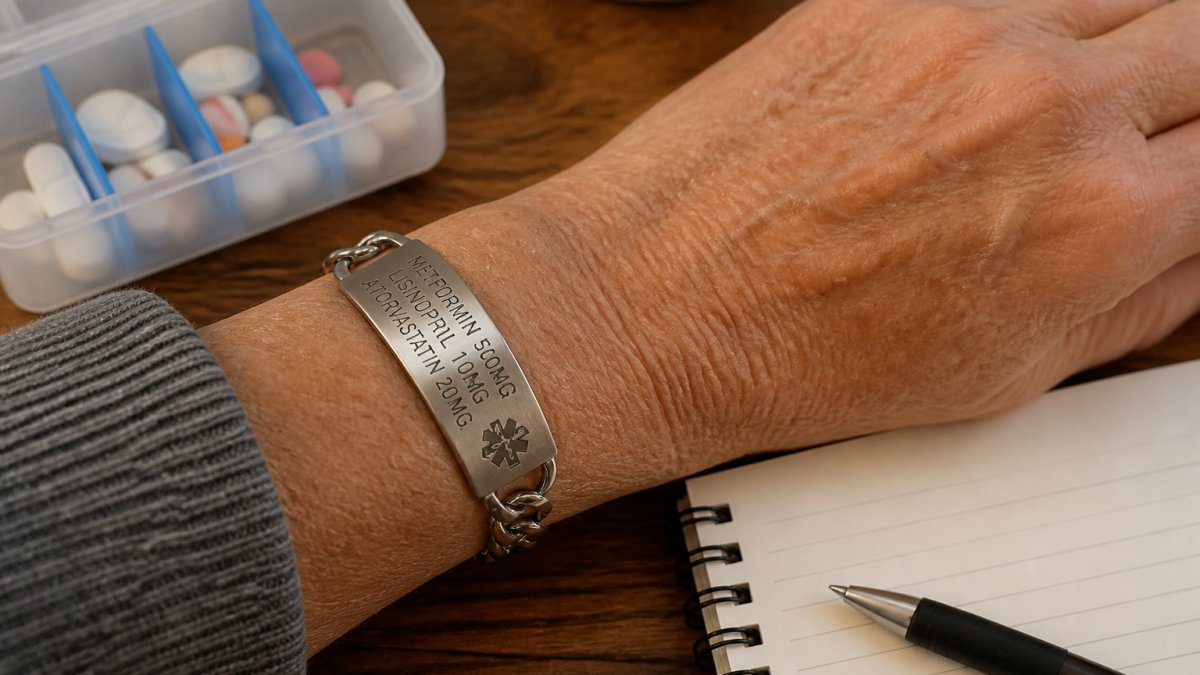
Start with the drug's generic name. It is usually shorter and recognized everywhere. Then add a short qualifier that carries the real risk. "Warfarin - blood thinner" tells a responder more than "Coumadin 5mg twice daily."
Keep these tips in mind:
- Use the fewest words that still make sense
- Put the highest-risk medication first
- Separate each item with a clear mark, like a slash
- Skip punctuation that wastes space
- Use uppercase letters for legibility
When you are ready to order, you can personalize the engraving on a custom text medical bracelet and choose from several band colors. For a deeper look at what to engrave across conditions, our guide to custom engraved medical ID bracelets for adults walks through more examples.

Medical Alert Bracelet Character Limits and How to Work Within Them
Medical alert bracelet character limits vary by plate size and style, so check the product page before you finalize your text. Most standard plates hold a modest amount of text on the front, with room for a few lines.
Character limits vary with plate size, font, and engraving method. Always confirm the exact limit on the product page for the specific bracelet you are ordering.
That budget is tighter than most people expect. Consider a realistic front-plate inscription:
- Line 1:
WARFARIN(8 characters) - Line 2:
BLOOD THINNER(13 characters) - Line 3:
SEE WALLET CARD(15 characters)
That is 36 characters plus line breaks, and it already fills a small plate. Add a name and a phone number and you are over budget. This is why the front should be treated like a headline and the back like a footnote.
Watch out: cramming a full medication list onto a small plate often means the most important word gets cut off or shrunk until it cannot be read.
When space is genuinely tight, prioritize in this order:
- The single highest-risk medication or condition (for example,
WARFARINorALLERGIC TO PENICILLIN) - A short qualifier that explains the risk (
BLOOD THINNER,SEVERE REACTION) - A pointer to more detail (
SEE WALLET CARDorSCAN FOR INFO) - Name and emergency contact, if the plate has room
If you want more room to work with, you can compare the range of custom medical bracelets and pick the style that suits your engraving needs.

A realistic front-plate inscription shows how quickly the character budget disappears.
Custom Text Medical Bracelet →
| Line | Example text | Characters |
|---|---|---|
| Line 1 | WARFARIN | 8 |
| Line 2 | BLOOD THINNER | 13 |
| Line 3 | SEE WALLET CARD | 15 |
| Total | 36 characters plus line breaks | 36 |
Pair the Bracelet With an Emergency Medical Information Card
An emergency medical information card does the job the bracelet cannot: it holds the full picture. The bracelet points to it; the card delivers the detail. Keep the two consistent, and keep the card where a responder will look.
A practical setup looks like this:
- Write your complete medication list, with doses, on a wallet card.
- Note your allergies and conditions on the same card.
- Add "See wallet card" to the bracelet engraving.
- Store a copy in your phone's emergency info section.
- Tell one family member where the card lives.
This pairing solves the space problem without sacrificing accuracy. The bracelet stays short and readable. The card stays complete and current.
When Digital Medical Alert Jewelry Makes Sense
Digital medical alert jewelry is a general category of ID products that can add a scannable code or profile link to a bracelet.
Access. Engraved text is readable by anyone, immediately, with no tool. A QR code or near-field communication (NFC) tag requires the reader to recognize it, decide to scan it, and have a device that can.
Privacy. Engraving puts your condition and medications on display for anyone who glances at your wrist. A code keeps the details behind a scan, which some wearers prefer for sensitive diagnoses or for children in school settings.
Connectivity and power. A digital profile depends on a charged phone, a working scan, a data connection, and a platform that stays online. Engraving depends on none of those.
Currency. A digital profile can be updated without re-engraving, which can be an advantage for people whose regimen shifts often. The profile is only as current as the last time someone updated it.
Cost and upkeep. Engraved stainless steel is a one-time purchase. Some digital ID platforms charge an ongoing fee for hosting a profile, so check their terms before you commit.
This approach helps in a few clear cases:
- You take many medications and want the full list available
- Your regimen changes often
- You want privacy, since the details sit behind a code rather than on display
- A caregiver manages your records remotely
A practical middle path is a bracelet with a short engraved line for the highest-risk medication, plus a code for the full list. If you prefer a durable, low-tech option, browse our stainless steel medical bracelets, which are made of stainless steel and nylon and do not require a battery or an app.

Keep the Medication Record Accurate as Prescriptions Change
An outdated bracelet can be worse than no bracelet. If it still lists a blood thinner you stopped six months ago, it can send care in the wrong direction. Accuracy is a habit, not a one-time task.
Build a simple review routine:
- Update the card every time a prescription starts or stops
- Re-check the bracelet at each refill cycle
- Photograph the card and store it on your phone
- Set a reminder to review the list every few months
- Replace the bracelet engraving when a critical medication changes
Many families find that one shared folder or a note on the fridge keeps everyone working from the same list. Caregivers who manage several people's medications should keep each person's record separate and clearly labeled.
Order a Custom Medical Bracelet From Life Heals Medical Supplies
A bracelet only helps if it is on your wrist and readable. That means choosing a style you will actually wear every day, with engraving you can trust.
At Life Heals Medical Supplies, we offer customized stainless steel medical identification jewelry. Our bracelets can be personalized with your condition, medications, allergies, or emergency contact, and they are delivered directly to your door. If you are choosing for an older family member, our guide on which medical alert bracelet for seniors is right for you can help you compare styles.
Ready to set up a bracelet that carries the right information? Join our email list to stay informed about our medical identification jewelry.
Frequently Asked Questions
What should be listed on a medical alert bracelet for a medication list?
Engrave only the medications that change how first responders treat you: blood thinners, insulin, corticosteroids, seizure medicines, and anything you are severely allergic to. Add the condition those drugs treat, such as a heart condition or diabetes, plus one emergency contact. Leave out routine drugs like statins or birth control tablets. A medical alert bracelet works as a prompt, not a full pharmacy record, so the goal is to flag what matters in the first minutes of an emergency.
How do I fit a long medication list on a medical alert bracelet when engraving space is limited?
Use clear abbreviations and drop the dosing schedule. Write 'Warfarin 5mg' rather than the full brand name and instructions, and skip extended-release labels unless the release type changes emergency care. If the list still will not fit, engrave the two or three most critical drugs and carry the rest on an emergency medical information card in your wallet. Check the medical alert bracelet character limits before you order so you know how many lines you have to work with.
Are there digital alternatives to engraved medication lists on bracelets?
Yes. Digital medical alert jewelry uses a QR code or NFC chip that links to a profile you update online, which solves the space problem entirely. The tradeoff is that a first responder has to notice the code and have a device to scan it, while engraved text is readable instantly and works without a battery. Many families use both: a bracelet with the top medications engraved and a digital profile holding the complete list.
How often should I update the medication information on a bracelet?
Review the engraving every time a prescription is added, stopped, or the dose changes, and at least once a year. Keep a written medication record at home with drug names, doses, and prescriber details, and bring it to appointments. If the bracelet engraving is out of date and cannot be redone quickly, replace it rather than wear outdated information. A bracelet that lists a discontinued blood thinner can mislead emergency care providers.
Getting the medication list right takes a little sorting, but it is one of the most useful things you can do for your own safety or a loved one's. Life Heals Medical Supplies makes the next step simple with personalized stainless steel bracelets, custom engraving for conditions and medications, and reliable delivery to your door. Get started with Life Heals Medical Supplies and wear a bracelet that speaks for you when you cannot.
